
People, Food, & Climate: Thinking holistically about what we eat

Beyond carbon emissions, how can soil science, regenerative agriculture, the built environment, and the policies that connect food cultures and communities, work holistically to make climate-conscious, transformative practices accessible in our own communities and ecosystems?

Join us for a discussion at the intersection of science, agriculture, policy, architecture, and the restaurant industry with:

  • Aaron Blaisdell, PhD, Professor of Psychology, UCLA (Moderator)
  • Paula Daniels, JD, Co-Founder and CEO, Center for Good Food Purchasing
  • Jorge Gaviria, Co-founder of Masienda and author of MASA
  • Paige L. Stanley, PhD, Postdoctoral Researcher at Cotrufo Soil Innovation Lab, Department of Soil and Crop Sciences at Colorado State University
  • Christian Stayner, M.Arch, Founder and Managing Principal, Stayner Architects & co-founder of Bacetti

This in-person event is FREE and open to the public with limited capacity. Please register on Eventbrite by 11:59pm, Monday, September 26.

If you have any questions, please email info@scienceandfood.org.

Venue accessibility and directions:

Science&Food at UCLA is organizing this event as part of the 2022 LA Times FoodBowl in partnership with EatWell Pod and Semel Healthy Campus Initiative (HCI) Center, with support from UCLA Rothman Family Institute for Food Studies, UCLA Food Studies Minor, Resnick Center for Food Law and Policy at UCLA Law, Innovation at the Nexus of Food, Energy and Water Systems (INFEWS), National Science Foundation, and California Nanosystems Institute, and UCLA Integrative Biology and Physiology (IBP).

About the featured speakers:

Dr. Aaron Blaisdell (Moderator) is a UCLA Professor of Psychology and Neuroscience, and a member of the Brain Research Institute, the Integrative Center for Learning & Memory, and the Evolutionary Medicine program. He received a BA in Anthropology (SUNY Stony Brook), an MS in Anthropology (Kent State University), a Ph.D. in Behavioral Neuroscience (SUNY Binghamton), and had 2 years of postdoctoral training (Tufts University). Dr. Blaisdell studies behavioral neuroscience and ancestral health. He co-founded the Ancestral Health Society and is Editor-in-Chief of the Journal of Evolution and Health.

Paula Daniels is Co-founder, Chief of What’s Next, and Founding Chair of the Center for Good Food Purchasing. She is a lawyer, and has held a number of senior executive positions in government on water policy in California and Los Angeles. She served as Senior Advisor on Food Policy to Mayor Villaraigosa of Los Angeles and taught food and water policy at UCLA for several years. She is an Ashoka Fellow, and a Stanton Fellow of the Durfee Foundation.

Jorge Gaviria is the founder of Masienda, a supplier of high-quality masa and masa products, and the company at the center of the heirloom masa movement in the US. Jorge trained at top restaurants, including Maialino and Blue Hill at Stone Barns, before founding his company in 2014. He has been recognized by top international press outlets for his work and was awarded Forbes 30 Under 30 for food and wine in 2017. He lives in Los Angeles. His passion is palpable in Masa, where he shares his research and expertise, including the knowledge he’s gained successfully working through tens of thousands of questions from home cooks – inquiries that cover everything from the best equipment to how to prevent a tortilla from falling apart during reheating.

Paige Stanley, PhD, is an interdisciplinary scientist working to understand how grazing management can sequester carbon (C) in soils to help mitigate climate change and build more resilient rangeland ecosystems. With a B.S. in Biology and Economics (Georgia College), M.S. in Animal Science (Michigan State University), and PhD in Environmental Science (University of California, Berkeley), she draws on a wide range of disciplines including soil biogeochemistry, grazing and rangeland ecology, agroecology, rancher sociology, and political ecology to approach research questions holistically. She is particularly interested in the use of “regenerative grazing” (or adaptive multi-paddock grazing) by ranchers on rangelands, and prioritizes on-ranch soil science work rather than highly controlled grazing experiments to ensure that her research captures soil C changes on real-life ranches, including from adaptive grazing management on large scales and long timeframes. Core to Paige’s work is centering ranchers throughout the research process, ensuring that research contributes to solving their on-the-ground challenges. To greatly improve real-world applicability, she incorporates social science methods to understand rancher mental models, including drivers and barriers of adoption for regenerative grazing, and works with a goal of creating science-informed policy for working rangelands.

Christian Stayner is a founding partner of Stayner Architects, a Los Angeles-based design practice that provides comprehensive architectural services across a broad range of scales and programs. He received his Masters in Architecture from the Harvard Graduate School of Design and his B.A. in Architecture and Human Rights Theory from Harvard College and the experimental liberal arts institution, Deep Springs College. Operating from its studio in Echo Park, Stayner Architects is a LGBTQ-led practice engaging exclusively with projects by non-profit public-benefit organizations such as schools, arts and culture organizations, and social service providers. They collaborate with entities who share a commitment to non-extractive business models. Beyond their architectural portfolio, Stayner Architects expresses ecological impact through self-directed missions like Tools & Utensils, an online resource for educational, cultural, and philanthropic institutions looking to advance the future of food on their campuses.
Early Modern cooking is a recipe for academic writing

Students in Professor Heather Sottong’s Food Studies 133W class spent time this summer completing a homework assignment in a place you might not expect: their kitchens.

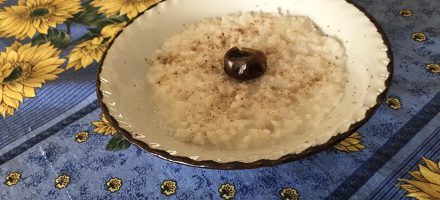
Their task was to attempt to cook a recipe from early modern Europe – that’s from around the 15th to 18th centuries. And recipes from this era were not exactly like the carefully detailed recipes we’re accustomed to today.

“Students probably can’t find all the ingredients. Most of these recipes do not tell you how long to cook. Sometimes they don’t tell you how much of each ingredient to put in,” Sottong said.

While the assignment is a fun and hands-on way to make the early modern texts come alive, Food Studies 133W, “Historical Recipes and a Recipe for History,” isn’t just about cooking. The course allows students to practice academic writing and historical research through the exploration of the social and political issues that are revealed through recipes of the late medieval and early modern period – issues that are still relevant today.

Beginning with a brief study of the ancient Roman table, students write a personal essay exploring an aspect of their personal identity through food. The course moves into medieval feasting and fasting, in which students write an argumentative essay about whether the fasting of religious women during the Middle Ages can be considered a form of anorexia nervosa.

Students then read cookery books for early modern housewives as well as texts by professional chefs of the era including Bartolomeo Scappi, which open up discussion of gender roles and social class in food and cooking. The course wraps up with a discussion of imperial taste, national cuisine and national identity before students write a research paper in which they develop an original argument based on textual evidence from a medieval or Early Modern culinary text.

The course fulfills Writing II GE credit in addition to credit for the food studies minor, and the class is a mix of students taking it for both reasons. Studying these early modern recipes is a great way to generate writing as well as explore the humanities, Sottong said.

For example, the conflicts and struggles illustrated in early modern cooking can be compared to today’s conversations about the role of women in cooking and other household responsibilities, or the inaccessibility of healthy food choices to certain segments of the population.

“These topics or the questions of food and identity are really close to home and students can easily get involved with the text,” Sottong said. “Perhaps a lot of them hadn’t thought about this way of approaching food studies. But there is so much material to be looked at from a humanistic standpoint.”

View the original post by Robin Migdol at UCLA Rothman Family Institute for Food Studies.

UCLA food studies institute to tackle global food challenges

Increasingly, scholars are studying food — its production, preparation, sharing, consumption and disposal — to better understand and tackle global challenges such as climate change, health and social disparities and labor conditions, and to improve access to information.

Already a leader in the emerging field of food studies, UCLA has created an interdisciplinary institute devoted to research, teaching and policy about food, made possible by an anonymous $13.5 million gift.

The UCLA Rothman Family Institute for Food Studies will bring together faculty, staff, students, chefs and members of the community and house UCLA’s popular food studies minor and graduate certificate program. The gift will provide ongoing funding for research, curriculum and library resources, including the first endowed food studies librarian at a university, as well as hands-on experiential learning opportunities such as a new chef-in-residence program that would begin in spring 2022. It will expand the offerings of the UCLA Teaching Kitchen, launched in 2019, which helps students learn to cook healthy and affordable meals and which has operated remotely during the pandemic.

“Food is central to the human experience, and this new institute will play a leading role in examining aspects of our relationship with food as well as the ways in which food systems tie into larger issues like public health, sustainability and economic well-being,” said UCLA Chancellor Gene Block. “The institute exemplifies what UCLA does so well, which is bring communities together alongside experts from across the disciplines to address some of society’s most complex challenges.”

The institute bolsters the UC Office of the President’s Global Food Initiative, created in 2014 and focused on how to feed a world population expected to reach 8 billion by 2025.

“UCLA is uniquely positioned as a leader in food studies,” said biophysicist Amy Rowat, UCLA’s Marcie H. Rothman Professor of Food Studies. “We are known for our strengths in the sciences and the arts, and have strong partnerships with community organizations dedicated to equal food access. We will also capitalize on UCLA’s location in one of the most diverse cities in the world, which is home to so many innovative chefs.”

Rowat, an associate professor of integrative biology and physiology in the UCLA College, is a pioneer in using food to introduce complex concepts in science to nonscientists. She is co-director of the UCLA Semel Healthy Campus Initiative EatWell pod and the founder and director of the Science and Food organization at UCLA. Rowat will spearhead many of the institute’s activities, including expanding her long-running science and food course and developing the chef-in-residence program, a 10-week interdisciplinary course in which chefs are paired with faculty to engage students on topics from food equity to the microbiome. Rowat’s lab will continue to develop sustainable options for food production.

Helping to advance the institute’s vision and Rowat’s work is UCLA Library’s new Rothman Family Food Studies Librarian. Alexandra Solodkaya is the first person to hold the position and she will curate a broad scope of food-related research and teaching services, materials and collections. Given the speed with which social media can amplify incorrect information, the food studies librarian will challenge students to think critically about sources.

“We are grateful for this gift — the largest in the division’s history — which will allow more of our students and faculty to delve into this growing area of inquiry,” said Adriana Galván, dean of the division of undergraduate education, who emphasized how the institute’s interdisciplinary approach would benefit students.

“Food can heal. The institute is looking at food from a system-based, interdisciplinary perspective to contribute to the health and well-being of the individual, community and the planet,” said Dr. Wendelin Slusser, associate vice provost of Semel Healthy Campus Initiative Center at UCLA, whose work across campus and in Los Angeles helped build the foundation for the institute.

View the original post by Elizabeth Kivowitz at UCLA Newsroom

UCLA introduces new institute providing interdisciplinary food studies education

A new institute is opening up at UCLA that focuses on a major part of daily life: food.

The new UCLA Rothman Family Institute for Food Studies under the Division of Undergraduate Education focuses on the interdisciplinary nature of food in research and education, said Adriana Galván, the dean of undergraduate education. It was made possible by an anonymous $13.5 million donation.

“This gift is completely transformative for UCLA because it is a place that will bring together scholars and students from a lot of different disciplines to coalesce around food,” said Galván.

The institute will also expand upon opportunities within current UCLA food studies programs, creating new spaces to learn about food sustainability, access to food, the chemistry of food and more. Researchers, whose work will also be supported and expanded by the gift, will have more opportunities to consult with their colleagues in other fields – such as psychology and policy – to more effectively implement their findings.

Dr. Wendelin Slusser, the associate vice provost of the Semel Healthy Campus Initiative Center, said the effort to create the institute was inspired by the university’s push to uncover innovative ways to promote living well on campus which began with UCLA’s Semel Healthy Campus Initiative in 2013.

A Semel HCI summit led to the establishment of UCLA’s food studies graduate certificate program, which allows students to explore the subject of food in an academic way related to their own interests – such as health, politics, social justice or history, Slusser added.

UCLA also currently offers a food studies minor for undergraduates – another product of the summit.

[Related: UCLA serves up food studies minor]

Dana Gillis, a fourth-year philosophy student pursuing a minor in food studies, said the interdisciplinary nature of food has been reflected by the diversity of classes she has taken. Course requirements span a range of departments, including anthropology, geography, urban planning and physiological sciences.

“Food is so central to all of our lives that it really penetrates through all different disciplines,” said Amy Rowat, the faculty chair of the food studies minor and associate professor and vice chair of graduate education in the integrative biology and physiology department.

Gillis said she appreciates the way food studies brings students together to share the different perspectives shaped by the cultures and foods they have enjoyed throughout their lives.

“What I’ve taken away from the classes is that there’s a deeper history to all foods and the way that they connect to culture and society,” Gillis said.

Slusser added that the diversity of minds being cultivated at UCLA will create thinkers prepared to solve future problems.

“It’s really to empower and educate the next generation of interdisciplinary leaders and game changers to address the major issues of our time around food,” Slusser said.

(Courtesy of Elizabeth Kivowitz)

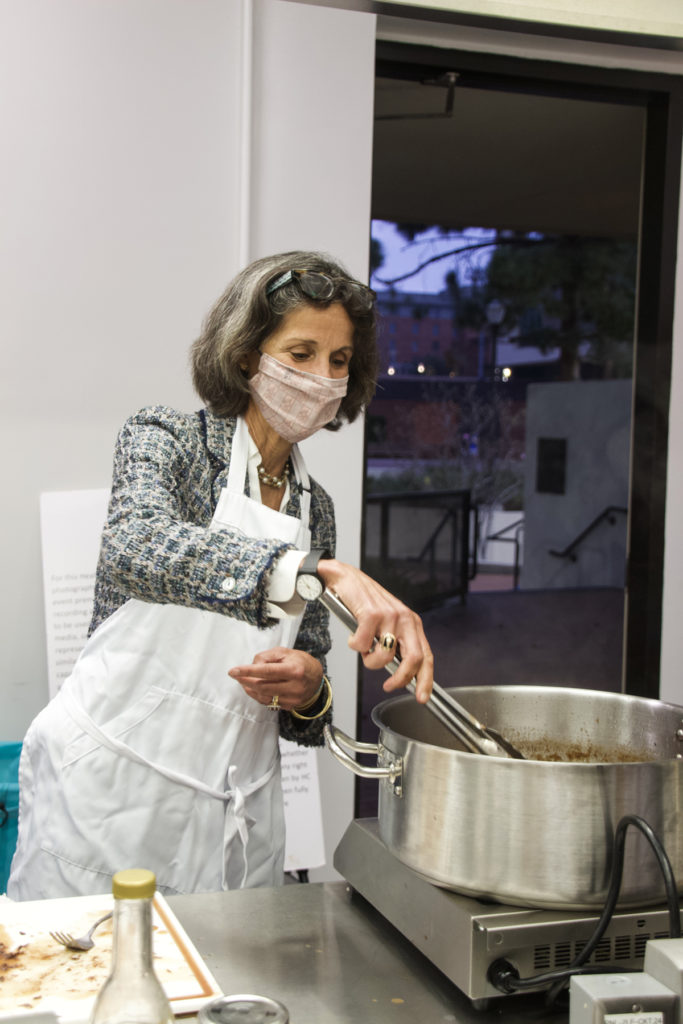
Dr. Wendelin Slusser works with food in the UCLA Teaching Kitchen. Slusser added that the effort behind the creation of the new institute for food studies followed and built upon the work of UCLA’s Semel Healthy Campus Initiative. (Courtesy of UCLA)

Rowat, who is also the current Marcie H. Rothman presidential chair in food studies, said the new institute will power an increase in the course offerings of food studies for undergraduates at UCLA.

With additional faculty supported by the institute, there will be more individuals dedicated to teaching and conducting research about food, Rowat said.

Rowat added that her own lab is currently working on sustainable protein production and using their expertise to cultivate animal protein by developing and utilizing new engineering approaches.

The institute will also encourage students to study existing research with the help of Alexandra Solodkaya, the Rothman Family food studies librarian. Solodkaya holds the first endowed position at any library across the country focusing specifically on food studies.

Solodkaya said she will be providing students with instruction on information literacy for any food-related courses – something she believes is crucial given online misinformation about food.

“Having a trained librarian who’s versed in information sourcing and citations and our sort of networked information systems is important to get at what is really accurate,” Solodkaya said. “That’s part of the education that we provide at UCLA.”

Students and faculty who are in the department or simply have an interest in food will be able to benefit from her knowledge, resources and connections, Solodkaya said.

Solodkaya said she aims to forge new connections – such as between North Campus students, with arts and humanities perspectives, and South Campus students, with knowledge in the sciences – to encourage collaboration and innovation.

“That’s really the beauty that the Food Institute brings and that the library can help enhance,” Solodkaya said.

Galván, who is also a psychology professor focusing on adolescent brain development, said there is tremendous value in students learning about food and healthy habits while they are preparing to be adults.

“College is a perfect time to give a more intentional and profound examination of food,” Galván said. “If we can impart the importance of thinking about what we eat, who has access to it and how we engage with it, we’re hopefully going to set the stage for lifelong healthy eating.”

Galván said she is also excited for more students to apply their knowledge in a practical setting in UCLA’s Teaching Kitchen through virtual and in-person programs and workshops that are available to all Bruins.

(Courtesy of Elizabeth Kivowitz)

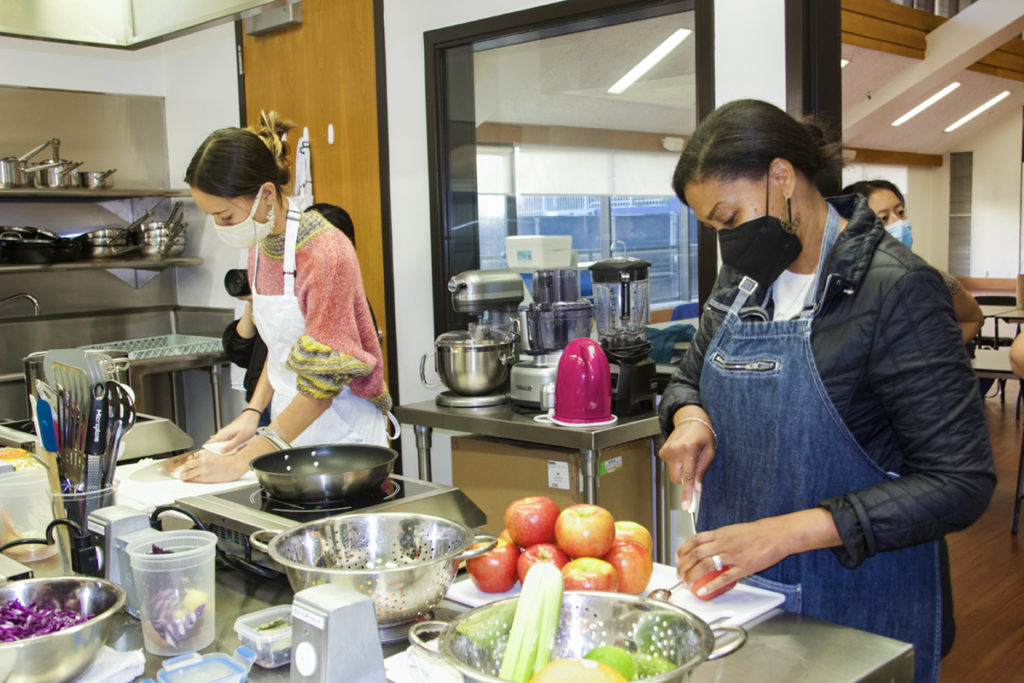
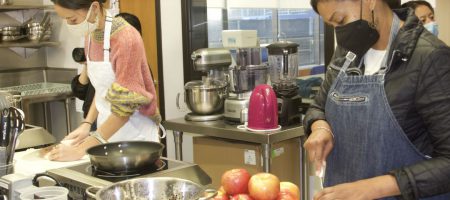
Students practice cooking skills in the UCLA Teaching Kitchen. Professors involved with the current food studies minor and graduate certificate programs emphasized the importance of an interdisciplinary approach to food studies and the benefits the new institute will bring to the campus community. (Courtesy of UCLA)

Launched in October 2019, the Teaching Kitchen is a space on campus for students to engage in both curricular and extracurricular activities through food and cooking, Rowat said.

While the COVID-19 pandemic halted in-person operations for a while, the kitchen found innovative ways to still reach out to the communities it intends to serve and educate.

“We were able to serve, through the Community Programs Office, hundreds of undergrad and graduate students who identified as food insecure education virtually on how to prepare meals that were healthy but also OK on the pocketbook,” Slusser said.

Slusser said she is excited that the new institute will support the people and resources needed to educate communities on improving daily choices and will further encourage and prepare the next generation of leaders.

“The whole premise of what we try and aspire to do is to raise the health and well-being of our community, students, staff and faculty from the bottom up,” Slusser said. “It’s been a grassroots effort and a community-organizing social movement to engage people.”

View the original post at the Daily Bruin